
Depression is NOT a result of your actions. It is NOT a result of doing something that is not according to your wishes or desires. Someone actually said to me that depression is a result of these things. No. It’s not. It’s not your fault. It’s not a persons fault if he or she suffers from depression. Depression doesn’t choose its “victims” according to their actions. You could have the greatest life in the world and still suffer from depression. You could have all the money you want and all the material things you want and *still* suffer from depression. It does not discriminate by race, age, gender, sexual orientation, how good ones life may be, or actions… and it can happen to *anyone.*
Tag: depression
It’s Okay To Ask For Help
It’s okay to ask for help. It’s okay to seek help. Asking for help or seeking help is not a weakness. We all need help in our lives, ALL of us. Seeing a therapist, psychiatrist, or psychologist is not a weakness. Taking medication for a mental illness is not a weakness. We were created to need each other, to build each other up, and to help each other. Don’t judge someone with a mental illness who asks for help or seeks help, instead, support them, show them love, and help them any way you can.
A Glimpse Into The Life of An Aspie
There are many people who don’t know anything about autism, or Asperger’s, which is on the autism spectrum. My husband, Marcos, lives in Brazil where Asperger’s really isn’t recognized, along with the mental illnesses that can come with having Asperger’s. You could have met someone with Asperger’s and maybe not even have known it… but there’s way more to living with Asperger’s than meets the eye. I conducted a small interview with my husband about Asperger’s and what it has been like to live with this condition, just to give people an idea of what life is like for an Aspie (a person who has Asperger’s).
How old were you when you were diagnosed?
Marcos: “Thirty nine. It was my fortieth gift.”
What was your initial reaction when you found out you have Asperger’s Syndrome?
Marcos: “I didn’t like it that much because, first it was just like the stigma, ‘oh you’re autistic,’ just the, you know, just pretty much I thought it was limited to slower people, I don’t know. But after that, it pretty much clarified a lot of my behavior so it’s pretty much, it matched my style, so in a way it was liberating.”
How long did it take you to accept that you have Asperger’s?
Marcos: “Not that long. I pretty much accepted from the beginning, from the gecko, I just read about it and said ‘yeah, that’s me, that’s undeniable’ so it was okay.”
Before your diagnosis, did you know anything about autism and/or Asperger’s?
Marcos: “Nope. Just the small one, group, of negative spectrum people that has autism that pretty much, they are living in another dimension. I never heard about functional autistics.”
There are three core areas, social interaction, communication, and imagination, that are mainly affected by Asperger’s, on different levels in each individual that has it. Which one of these areas would you say is affected the most for you due to Asperger’s?
Marcos: “All of them.”
All of them? So there’s not one particular area that is affected more than the other?
Marcos: “Well, communication is bad, social skills are horrible, and imagination is pretty much off the charts.”
How does your immediate family feel about your diagnosis?
Marcos: “Initially they did not believe at all, the same reason, they thought autism was pretty much limited to the negative spectrum. After that, they just read about it, some of them actually, but most of them, they don’t really care that much. They just say ‘he’s just crazy.'”
So they think you’re crazy?
Marcos: “Yeah, but not mad, not like stark raving mad.”
Asperger’s usually has an impact on mental health, resulting in mental illnesses like depression, anxiety, and even personality disorders. How has Asperger’s impacted your mental health?
Marcos: “Very negatively, speaking. Just like a lot of my depression can be contributed to that I think, especially when I was un-diagnosed. And anxiety has always been present, especially on social occasions because I know I’m awkward, and pretty much cannot communicate that much with anyone that I don’t know. Especially when un-diagnosed, I think it’s worse. You just think you’re crazy, ‘what’s wrong with me?’ But after that, you know what’s wrong with you, which means nothing, you just have Asperger’s.”
So it’s better to get the diagnosis?
Marcos: “Oh yeah.”
Do you take things literally?
Marcos: “Yes, I do. Especially, sometimes metaphorically and figuratively speaking, sometimes I don’t get it, I take it literally.”
Looking back throughout your life, would you say that Asperger’s prevented you from doing some of the things you wanted to do?
Marcos: “Yes it did.”
Majorly?
Marcos: “Majorly, because even though… I tried teaching for instance, I can’t do it. Too much anxiety. Too much awkwardness. I suppose it would… when I wasn’t diagnosed, I was thinking ‘oh maybe I’ll just work this out’ but it’s pretty much forcing something that sometimes you can’t help it. And most of the social interactions that I had, just pretty much, sometimes, everyone speaking, I just don’t know what to say. Just ‘if I say this, then it will cause this to happen’ and overthinking, overthinking, overthinking.”
Do you over-react to situations a lot?
Marcos: “A lot. A lot. Yes.”
How does over-reacting affect you?
Marcos: “Badly. Because it’s not just about pessimism, it’s just about seeing the worst type of scenario possible.”
Always the worst case scenario?
Marcos: “Yeah, the worst case scenario, and just… it makes me pretty much like, sometimes the stuff that wouldn’t bother 99% of the population, if something falls to the ground, just aaaaahhhhhh!”
Would you say you were bullied more than the other kids were in school?
Marcos: “Yeah, I was. Definitely. Yes, a lot. Cause I couldn’t properly come with responses and interact with them just like playfully, I would take things seriously, way too seriously, like taunts and such, instead of just letting go I would react badly and that’s pretty much a propeller for bullies.”
Having autism/Asperger’s is a risk factor itself for attempting suicide. Have you ever attempted to take your own life?
Marcos: “Yes, a lot of times.”
How many times?
Marcos: “Nine times.”
How old were you your first attempt?
Marcos: “Fourteen. Something like that.”
Do you get angry a lot over things that would be considered irrational to others?
Marcos: “Yes, I do. A lot.”
How do you usually deal with that anger?
Marcos: “Not that good, just pretty much, it controls my subconscious. I become really withdrawn because I know I am angry in a way that’s not normal and I don’t want to bother people so I pretty much retreat and stay by myself until it subsides someway, somehow.”
How has having Asperger’s affected you the most?
Marcos: “Socially wise… even presentations in front of people would sometimes lead to a panic attack which is not only horrible, but people think you’re crazy just because it’s just a presentation, just speaking in front of other people, and I couldn’t handle it. The anxiety is just pretty much off the charts because of that. And if I went to a public place that I didn’t know, I would pretty much be hiding in the corner like ‘don’t talk to me.'”
So a presentation or a public place, something that would seem normal to a neurotypical person, is totally the opposite for you, with having Asperger’s, the anxiety is very very real?
Marcos: “Yes. Like those situations… just like a lot of times I ran out of places because I knew if I would stay there I would have a panic attack instinctively.”
Irritability In Depression
When a person is in a depressive episode, it is vital to know with what they say, what’s them and what’s not them. Irritability is common in a depressive episode, so if they snap at you, if they lash out at you and say anything against you, do not take it personally. It’s not them talking, it’s the depression. And it is vital that you do NOT snap back. This will only worsen the situation and drive them deeper into the episode. It is vital to know what is them, and what’s not them in a depressive episode. Just whatever you do, do not snap back at them. Be patient with them and continue to show them love. 💚
It’s Okay To Feel…
Contrary to what some people believe, it’s okay to feel depressed, sad, frustrated, and angry. We are merely human beings and emotions are part of us. Life is not perfect and we are not perfect, and that’s okay. Allow yourself to feel these emotions, accept these emotions, and remember that they will not last. You won’t always feel depressed, sad, frustrated, or angry. And if you need to, you can cry. It’s okay to cry. Sometimes that’s all we can do. And it’s not a sign of weakness to cry, or feel depressed, sad, frustrated, or angry. And it’s not a sign of weakness to talk about your emotions. Sometimes talking about them, having someone to listen to you, can help a great deal. 💚
Somebody Loves You
In the midst of darkness, it can seem and feel like no one cares, especially when people are so focused on “fixing” or “changing” someone with a mental illness, instead of just being there for them and loving them. A person suffering from a mental illness does not need to be “fixed” or “changed”… they need love, they need hope, they need to be accepted, and they need to be heard. All who suffer from a mental illness… please know and remember that somebody does love you and accept you, just the way you are (mental illness included), and you are more than good enough, just the way you are. 💚

Negative Thoughts Are Lies
Any negative thought that goes through your mind is a lie. It’s not true. You are not who your depression makes you out to be. If you suffer from depression, try to start telling yourself this when it’s the easiest to start, meaning while you’re not in a depressive episode. Write it down if you can and tell yourself this everyday; “the negative thoughts are lies. I’m not who my depression makes me out to be. My depression does not define me.” You are loved just the way you are and you are good enough just the way you are.
Things You CAN Say To A Depressed Person
There are many many things that you can (and should) say to a person who suffers from depression, here are 15 of those things, just to give people an idea of how to talk to someone with depression. Be kind in the words you speak. Let your words, and your actions, radiate love and compassion.
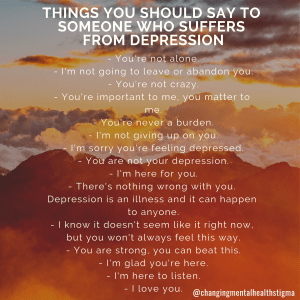
Things you can (and should) say to a person who suffers from depression:
- You’re not alone
- I’m not going to leave or abandon you
- You’re not crazy
- You’re important to me, you matter to me
- You’re never a burden
- I’m not giving up on you
- I’m sorry you’re feeling depressed
- You are not your depression
- I’m here for you
- There’s nothing wrong with you. Depression is an illness and it can happen to anyone
- I know it doesn’t seem like it right now, but you won’t always feel this way
- I’m glad you’re here
- I’m here to listen
- I love you
What NOT To Say To A Depressed Person
For someone who doesn’t suffer from depression, it’s easy for him or her to forget about certain things that are said to him or her, like the comments on this list. For someone who suffers from depression, however, it is not that simple and can actually amplify his or her depression. While there are many more things that you should never say to someone who suffers from depression, here are 15 of those things. Be careful in the words you choose while talking to someone who suffers from depression; it could literally be the difference between life and death.
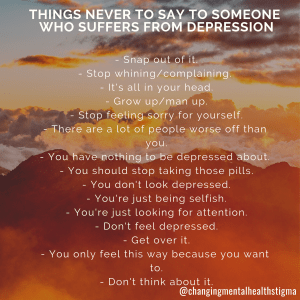
Things you should NEVER say to someone who suffers from depression:
- Snap out of it.
- Stop whining/complaining
- It’s all in your head
- Grow up/man up
- Stop feeling sorry for yourself
- There are a lot of people worse off than you
- You have nothing to be depressed about
- You should stop taking those pills
- You don’t look depressed
- You’re just being selfish
- You’re just looking for attention
- Don’t feel depressed
- Get over it
- You only feel this way because you want to
- Don’t think about it
Depression
There are so many people who think depression isn’t real, that it’s all just in a persons head. Most of these people think it’s not real because they don’t suffer from it. Some people suffer from it without even knowing they do. If you are experiencing any of the symptoms listed, you may be suffering from clinical depression. Don’t be afraid to reach out for help and know that you are not alone and there is hope. Depression is not a sign of weakness or a character flaw. It’s a mental illness and it can happen to anyone. If someone you know is showing signs of the symptoms listed, please reach out to them, calmly, patiently, and non-judgmentally. And please keep in mind, depression is not just in a persons head and they cannot just “snap out of it.”
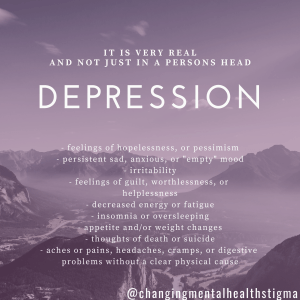
Symptoms of depression:
- feelings of hopelessness, or pessimism
- persistent sad, anxious, or “empty” mood
- irritability
- feelings of guilt, worthlessness, or helplessness
- decreased energy or fatigue
- insomnia or oversleeping
- appetite and/or weight changes
- thoughts of death or suicide
- aches or pains, headaches, cramps, or digestive problems without a clear physical cause
 mentallycompassionate.health.blog